How Does Google Ranking Work? The Business Owner’s Guide to Organic Search Visibility
Learning how Google ranking works is the definitive foundation for any modern commercial operation seeking to build a sustainable digital customer acquisition engine. In high-density, hyper-competitive markets like Delhi and the wider Delhi NCR, online search real estate directly dictates corporate growth by establishing a direct correlation between organic visibility, inbound leads, and compounding revenue.
Every single day, thousands of decision-makers use search engines to source B2B services, retail vendors, and digital agencies. If your website does not appear when they look for a solution, your target audience is seamlessly flowing to your competitors. Many local business owners treat the search algorithm like an unpredictable black box. In reality, Google runs on highly structured, logical systems.
The historic landscape of search has fundamentally transitioned away from simple, linear indexation toward complex, real-time user-intent alignment. To successfully command these modern systems, business owners must understand the core economics of search—specifically, how Google balances its massive computational server costs with its primary corporate mandate of delivering absolute user satisfaction. By reading this master guide, business decision-makers will acquire the technical literacy and strategic skills required to transform their digital footprints into highly authoritative, conversion-optimized assets capable of outperforming legacy industry competition.
Phase 1: Discovery—How Google Finds and Maps Your Business Website
Before Google can rank your website, it must move your pages through a strict technical assembly line. If there is a break at any stage of this pipeline, your content will fail to show up in search results.
Crawling: Deploying Search Spiders to Read Your Website’s Assets
Google maps the web via Googlebot, utilizing an automated crawling process that requests, downloads, and analyzes page source code. Under mobile-first indexing rules, the smartphone crawler evaluates your mobile responsive layout as the primary baseline for your entire site.
Crawlers rely on hyperlinks as discovery pathways; without these internal and external paths, unlinked pages become “orphaned” and are dropped from the crawl route entirely. To streamline discovery and ensure efficient crawling, webmasters must submit an XML sitemap via Google Search Console to provide a clean architectural blueprint of high-value landing zones. How often bots return—known as crawl frequency—depends heavily on your site’s domain popularity and server capacity. Common crawl obstacles like 5xx server errors, messy robots.txt blocking configurations, and severe site speed bottlenecks will exhaust the bot’s processing window, forcing it to abandon the page before completion.
Indexing: How Google Organizes and Stores Your Pages in Its Global Database
Indexing processes and categorizes downloaded data into Google’s database. First, the Web Rendering Service (WRS) parses your HTML, CSS, and JavaScript files to fully compile the visual layout of the page.
During content analysis, algorithms break this layout down into structuralized layers to evaluate text, headings, and images. Think of indexing as earning your spot on the library shelf; your business cannot be discovered by customers until your pages are properly cataloged in the grand directory.
Modern search systems look past flat strings of text to understand semantic entities and topics—mapping your text layout against the global Knowledge Graph to link your pages to real-world concepts, locations, and brands. To maintain database efficiency, duplicate content handling uses strict canonicalization tags to index one authoritative master version. Pages fail to index entirely if they drop below quality thresholds due to thin text, unoriginal data, or deceptive soft-404 traps.
Managing Crawl Efficiency: Ensuring Critical Business Pages Are Seen First
Google enforces a strict crawl budget, which represents the maximum number of unique URLs its automated bots will evaluate per visit to a domain. To maximize this limited window of attention, you must maintain a highly logical site architecture with clear, shallow directory trees so bots find important pages immediately.
Reinforce this structural discipline with strategic internal linking layouts to seamlessly distribute link equity and discovery pathways down from high-authority hubs. Keep priority commercial landing pages close to the root domain folder so your money-making service assets are never buried deep out of reach.
Phase 2: Interpretation—How Google Understands What Your Page Is About
Google’s primary corporate goal is to deliver the most accurate, zero-fluff answer to the searcher’s query. To win the ranking race, your content must align flawlessly with how the search engine processes intent.
Moving Beyond Keywords: Understanding Topics, Entities, and Context
The historical era of manipulating search results via keyword density—the mechanical repetition of specific phrases within a block of text to force search relevance—is entirely obsolete. Modern organic search relies completely on semantic mapping, natural language processing, and topic clusters. Google does not view a webpage as an isolated checklist of keywords; it treats it as an integrated conceptual ecosystem.
To establish authentic authority, business websites must construct defined topic clusters. This methodology requires launching an overarching, highly comprehensive “pillar page” that covers a broad service node in depth, which then links to and receives links from highly specialized “cluster pages” answering granular sub-topics. By building these clear semantic relationships, you signal to Google’s algorithmic layers that your platform possesses deep, comprehensive domain knowledge, shifting your optimization strategy from isolated keywords to complete topical ecosystems.
How Google Interprets Search Intent
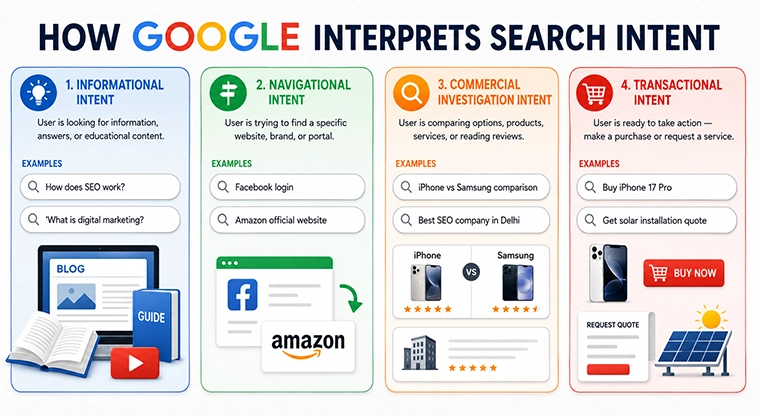
At the core of every search query lies a specific human objective. Google’s primary mission is to decode this objective, known structurally as search intent, and deliver the exact content format that satisfies it. Search intent is categorized into four distinct commercial segments:
- Informational Intent: The user is actively seeking answers, educational data, or guides. They are best served by comprehensive blogs, whitepapers, or step-by-step tutorials.
- Navigational Intent: The user is attempting to locate a specific brand, portal, or official corporate website directly.
- Commercial Investigation Intent: The user is comparing products, agencies, pricing, or models. They are best served by comparison tables, case studies, and review summaries.
- Transactional Intent: The user is highly motivated and ready to buy, request an immediate corporate quote, or sign an online service contract.
If a landing page targets a transactional phrase but features long-form informational text, Google’s real-time ranking filters will recognize the user engagement mismatch and favor competitor layouts that let the user take action immediately.
Semantic Search and Google’s Understanding of Meaning
Semantic search allows Google to analyze the underlying meaning, context, and relationships of terms within a query, rather than relying on exact-match phrasing. This capability relies on mapping related concepts and synonyms. The algorithm knows that if a page claims to specialize in corporate asset management, it should naturally feature related terms like portfolio diversification, risk mitigation, and fiscal compliance. The presence of these related terms validates the authenticity of the text.
Simultaneously, advanced Natural Language Processing (NLP) models allow algorithms to read and interpret human content like an educated reader. These machine-learning systems evaluate sentence structure, structural context, and topical relevance across an entire website’s footprint rather than analyzing pages in total isolation.
Phase 3: Evaluation—The Core Signals Google Uses to Assess Quality
Following discovery and interpretation, Google evaluates pages against competing documents using specific quality filters to score your site across three performance layers.
On-Page Relevance: Aligning Content with User Intent
The first evaluation layer is on-page relevance, measuring how accurately your copy answers the user’s specific query. High on-page relevance requires total content quality, meaning information must be highly accurate, unique, and comprehensive. Primary search concepts should be integrated naturally into key structural areas: the main H1 title tag, the URL string, subheadings, and body paragraphs. True optimization demands complete topic coverage, resolving the user’s inquiry entirely so they do not return to the search results to find a better answer. This structural clarity builds search satisfaction, proving to the algorithm that the asset successfully solved the user’s problem.
Technical Health: Measuring Accessibility, Performance, and User Experience
A website can feature exceptional writing, but if its underlying technical foundation is fractured, its ranking potential will remain limited. Technical health represents the structural performance required to pass modern accessibility, stability, and speed filters.
- Mobile Friendliness: Under mobile-first indexing rules, mobile layouts must feature flawless responsive design, fluid navigation, and readable font sizes.
- HTTPS Security: Securing customer data through an active SSL certificate is a non-negotiable baseline trust requirement across all modern commercial domains.
- Site Speed and Core Web Vitals: Google measures real-world user experience using three strict performance metrics:
- Largest Contentful Paint (LCP): Measures visual loading speed, targeting 2.5 seconds or less.
- Interaction to Next Paint (INP): Measures page responsiveness and input delays, targeting 200 milliseconds or less.
- Cumulative Layout Shift (CLS): Measures visual stability, ensuring page elements do not shift unexpectedly, targeting a score below 0.1.
Technical accessibility ensures clean code layouts, clear text hierarchies, and optimized alt tags allow both users and automated search engine crawlers to navigate your site without technical friction.
Off-Page Authority: Building Digital Trust Across the Web
While internal optimization establishes what your page is about, off-page authority signals how much the broader internet trusts your operation. This evaluation relies primarily on backlinks—hyperlinks from external websites pointing to your domain. In search architecture, an external backlink represents a vote of confidence. However, a single link from an established, industry-relevant domain carries far more weight than hundreds of links from low-quality, unrelated blogs.
Beyond direct hyperlinks, Google tracks unlinked brand mentions. When authoritative news outlets, digital journals, or industry blogs cite your exact business name without hyperlinking, algorithms process that mention as validation of market presence. For local enterprises, this is reinforced by citations across regional business registers. Ensuring your corporate name, address, and phone number (NAP) are perfectly uniform across local directories builds a clean geographical footprint. This network of external signals establishes your digital reputation, helping the algorithm confirm that your business is legitimate, active, and trusted.
Phase 4: Ranking—How Google Chooses Which Results Appear First
When a user types a query—such as “corporate website design for Delhi companies”—Google instantly searches its index to pull out the absolute best answers. The core mechanics of how Google Search ranks results involve evaluating hundreds of complex factors in fractions of a second to arrange them in order of relevance, trust, and user experience.
Relevance: Determining the Best Match for the Query
When a query is executed, Google’s real-time filters instantly isolate the most precise matches from its global database index. The algorithm parses the search query, checks for hidden intent markers, and surfaces pages that show the highest contextual alignment with the request. Pages that do not pass this initial relevance check are excluded from the live auction entirely.
Authority: Evaluating Which Source Deserves Trust
Once relevance filters narrow down the possibilities, the ranking engine determines which pages deserve premium positions by evaluating link equity profiles. The core algorithm traces the historical web of backlinks to measure which website stands as the most authoritative source on the topic. A relevant page backed by a highly trusted network of industry links will consistently outrank unproven domains.
User Experience: Prioritizing Fast and Accessible Websites
When multiple pages present similar levels of relevance and authority, Google uses user experience scores as the ultimate organic tie-breaker. If two corporate sites feature equally deep content and matching link profiles, the platform that loads faster, offers superior mobile usability, and achieves better Core Web Vitals will claim the top position. Google prioritizes user retention, systematically favoring websites that load without friction.
Freshness: When Recently Updated Content Wins
For dynamic, seasonal, or trending topics, Google activates an algorithmic mechanism known as Query Deserves Freshness (QDF). When a user searches for rapidly changing market info, the QDF filter prioritizes newly published or recently updated content over older historical pages. To leverage this, businesses must continuously audit and update their core informational guides to ensure all data remains accurate and timely.
Personalization and Location Signals in Search Results
Organic search results are no longer static or uniform. Every page layout is adjusted in real time by personalization and location signals. Google analyzes the user’s physical location via GPS coordinates or regional IP blocks, alongside their individual browser history and device type. A user searching for a business service in one neighborhood will see a completely different set of organic results than a user entering the exact same phrase a few miles away, making localized optimization essential for regional market dominance.
Phase 5: The Modern Shift—How AI and Machine Learning Influence Rankings
Understanding RankBrain and Google’s Evolution Beyond Exact-Match Keywords
The integration of artificial intelligence into organic search began with RankBrain, Google’s foundational machine-learning algorithm component. RankBrain moved search beyond rigid word-for-word matching, allowing the engine to handle obscure or completely unique queries that it had never encountered before. It works by translating vast strings of text into mathematical vectors, allowing the system to accurately map a user’s true intent based on contextual similarities to past searches.
How Machine Learning Helps Google Interpret Complex Searches
Following RankBrain, Google introduced advanced neural-network language models designed to interpret conversational human speech with profound accuracy. These systems analyze sentences bi-directionally, evaluating the complete context of a phrase by looking at what comes both before and after a word. This allows the search engine to understand the subtle nuances of conversational search queries, meaning business owners no longer need to write rigid, unnatural-sounding phrases to clear search thresholds.
Google’s Quality Systems and the Role of E-E-A-T
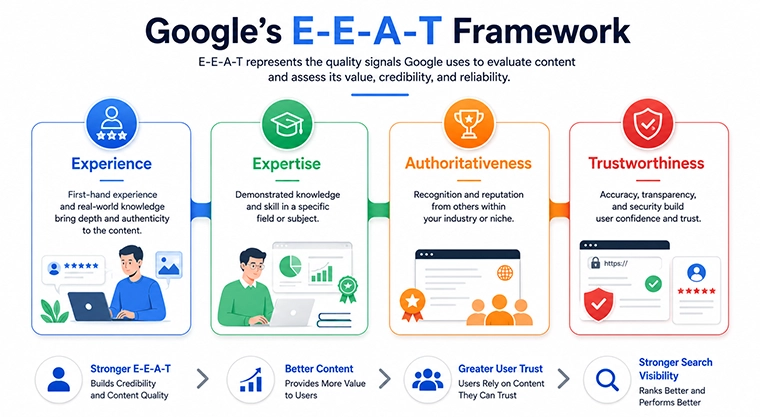
To maintain search integrity against an explosion of automated web spam, Google deploys an array of automated quality systems. As detailed in the official Google Search ranking systems guide, these frameworks scan indexed content for proof of real human execution and utility, guided closely by the concept of E-E-A-T: Experience, Expertise, Authoritativeness, and Trustworthiness. While E-E-A-T is not a single code-level metric, it represents the core quality standard that Google’s core algorithm updates reward across every commercial vertical.
AI Overviews, Voice Search, and the Future of Organic Visibility
The modern search landscape is shaped by generative AI snapshots known as AI Overviews. These summaries sit at the absolute top of the search results, synthesizing direct answers from multiple indexed sources simultaneously. To gain visibility inside these conversational summaries, business owners must adapt their formatting. AI architectures prioritize structured data, concise definitions, clear semantic entities, and explicit question-and-answer blocks that can be easily parsed by generative models.
Phase 6: How Google Evaluates Trust in Business Websites
When it comes to ranking businesses, Google takes user safety incredibly seriously. It filters search results through a strict quality evaluation framework tailored for commercial websites.
Experience: Demonstrating Real-World Knowledge
Trust is the ultimate operational currency in organic search. To pass Google’s quality evaluations, a business website must showcase authentic Experience. This requires providing clear indicators of first-hand, real-world knowledge of your trade. The algorithm is designed to identify and reward content that features unique data, step-by-step imagery, and actual project case studies. Websites that rely entirely on generic stock photos and rehashed theory struggle to rank against competitors who showcase real photos of their teams delivering services.
Expertise: Showing Industry Competence
Expertise requires that the informational substance of your platform demonstrates high industry competence. For critical niches—especially those categorized as Your Money or Your Life (YMYL), such as tax, law, or finance—Google enforces strict accuracy standards. Content should be authored or thoroughly reviewed by credentialed industry professionals, backed by transparent author bios and links to verified professional profiles to confirm subject-matter expertise.
Authoritativeness: Building Recognition Across the Web
Authoritativeness measures your broader reputation as an industry leader. Google determines this by analyzing whether your platform has become the definitive, go-to source that other reputable publications naturally link to. When leading digital platforms, corporate blogs, and industry journals consistently cite your content as an authoritative reference, your domain establishes a clear topical footprint that commands long-term organic rankings.
Trustworthiness: The Foundation of Google’s Quality Assessment
Trustworthiness serves as the absolute foundation of Google’s quality assessment criteria, measuring the transparency, security, and legitimacy of your business operation. A high-trust domain must feature explicit structural indicators: a secure HTTPS connection, transparent corporate contact channels, a verifiable physical address, and explicit business policies, including an accessible Privacy Policy and clear Terms of Service.
Phase 7: Local Search Optimization—Dominating regional Markets
The Difference Between Traditional SEO and Local SEO
For companies operating within defined geographical boundaries, understanding the structural split between traditional SEO and local SEO is critical. Traditional organic optimization focuses entirely on broad informational or commercial terms, ranking websites based on global topical depth and universal link authority. Local SEO, conversely, is explicitly geo-targeted, capturing location-centric user intents and shifting the search layout from standard text links to highly visible, map-based interfaces.
The Local Ranking Formula: Relevance, Distance, and Prominence
The positions within Google Maps and the local Map Pack are governed by a specific mathematical triad that operates independently of standard organic ranking signals:
- Relevance: How accurately your Google Business Profile and local landing pages match the explicit or implied search intent.
- Distance: The physical distance between the user’s real-time GPS coordinates or IP hub and your physical corporate location.
- Prominence: The overall digital weight of your brand, calculated using offline fame, local review counts, regional citations, and the traditional organic authority of your primary website.
Google Business Profile and Local Visibility
The absolute control center for your regional search footprint is your Google Business Profile (GBP). A proper local setup requires selecting accurate primary and secondary categories that match your exact business model. Beyond initial creation, businesses must maintain continuous optimization: publishing consistent post updates, uploading project photos, and actively managing user reviews. A steady influx of authentic customer reviews containing localized phrases acts as an incredibly powerful signal for map visibility.
Building Local Authority in Competitive Markets Like Delhi NCR
In hyper-saturated markets like Delhi, standing out requires building a localized topical footprint. Businesses can achieve this by weaving specific operational zones naturally into their service content. Instead of deploying generic target keywords across every layout, a firm should build unique pages tailored to sub-markets like Okhla, Connaught Place, or Gurugram. By discussing localized case studies and regional challenges, you build local topical prominence without risking keyword stuffing penalties.
Phase 8: The Accountability Audit—Why Websites Fail to Rank
When a website’s organic visibility drops significantly, an accountability audit is required to diagnose systemic failures.
1. Technical Problems That Prevent Crawling and Indexing
The most devastating issues stem from technical problems that prevent crawling and indexing entirely. These include accidental robots.txt blocks, where a developer might leave a restrictive command live after a migration, rogue noindex instructions embedded in high-value page headers, and critical server errors that force Googlebot to abandon the domain.
2. Content That Fails to Match Search Intent
Another common operational pitfall is publishing content that fails to match search intent. Many brands waste capital producing deep informational blogs for keywords where the buyer is actively looking to complete an immediate transaction. If the layout of your landing page forces an information-seeker into a hard-sell funnel, or forces a transaction-ready buyer to read pages of unnecessary text, users will exit your site immediately, destroying your ranking potential.
3. Weak Authority and Lack of Trust Signals
Websites frequently stall in search results due to weak authority and a complete lack of digital trust signals. If your domain features a stagnant backlink profile—meaning no reputable external websites have linked to your business in months—Google will interpret this as a decline in industry relevance. This issue is amplified when a brand avoids industry-specific digital PR, leaving the website isolated from the broader digital ecosystem.
4. Competition, Saturation, and Algorithm Update Impact
Entering a hyper-saturated market and attempting to target broad, short-tail keywords puts you in direct competition with legacy brands that possess decades of accumulated authority. Furthermore, Google rolls out broad core updates multiple times a year to refine its automated quality systems. If your content relies on low-value techniques, these updates will adjust your visibility downward. Conversely, a manual action occurs when a human reviewer issues a formal penalty for violating webmaster guidelines, requiring total technical remediation and an official reconsideration request.
Final Thoughts on How Google Ranking Works
Google ranking is a multi-layered progression where technical crawling, database indexing, and core algorithmic evaluation must align seamlessly. Succeeding in today’s organic ecosystem requires a critical balance: your platform must marry exceptional, user-centric content with rigid technical compliance and sustainable, white-hat authority.
As search behavior evolves, there is an immediate need to future-proof your digital assets for AI-driven search behaviors and generative engine optimization. For business decision-makers navigating the hyper-dense Delhi and larger Delhi NCR marketplace, local dominance demands a compounding, long-term asset strategy rather than volatile, quick-fix hacks.
Ready to secure your digital footprint? Partner with our team for professional SEO optimization and rigorous technical auditing services to transform your website into an authoritative, future-ready search asset.
Frequently Asked Questions for Business Decision-Makers
Can I pay Google directly to guarantee a top organic ranking?
No. Google maintains an absolute structural wall between paid advertisement auctions (Google Ads) and organic search ranking algorithms. Organic search positioning cannot be bought or influenced through advertising spend; it is earned exclusively through technical compliance, contextual relevance, and digital authority.
How long does it take for a new website to rank on Google?
For completely new domains, it typically requires 3 to 6 months of consistent optimization to secure meaningful organic visibility. This delay is a result of the algorithmic sandbox effect, during which Google’s quality systems evaluate the platform’s long-term security, content consistency, and overall operational legitimacy.
Why do rankings fluctuate from day to day?
Daily organic rank fluctuations are completely normal. They are driven by continuous real-time data adjustments within Google’s infrastructure: minor algorithm updates, competitor content refreshes, changes in user search patterns, and shifts in real-time location signals. Long-term trend analysis over months is a far more accurate performance indicator.
Does Google favor large brands over small businesses?
Google’s algorithms prioritize domain authority and trust, which legacy brands naturally accumulate over time. However, small-to-medium enterprises can consistently outrank massive competitors by building deep topic clusters, optimizing for local search signals, and targeting specialized long-tail keywords that larger platforms systematically overlook.
How many ranking factors does Google use?
Modern search operates via unified machine-learning models rather than a rigid checklist of separate rules. Google utilizes several core algorithmic systems that evaluate thousands of real-time variables simultaneously, focusing primarily on relevance, technical performance, and user trust.
Do backlinks still matter in modern SEO?
Yes. Backlinks remain one of the most powerful signals of authority and trust within Google’s evaluation systems. However, the modern focus has shifted entirely from quantity to absolute quality. A single backlink from an authoritative, industry-relevant publication passes significantly more value than thousands of low-tier links.
Can AI-generated content rank on Google?
Yes, AI-generated content can rank, provided it is high-quality, accurate, and created to give real value to human readers. Google’s official documentation states that it rewards quality content regardless of how it is produced. However, unedited AI text that lacks original data or human review will fail to clear modern E-E-A-T quality thresholds.
Why is my page indexed but still not ranking?
When a page is successfully indexed but fails to secure organic impressions, it means it cleared the discovery and storage phases but fell short during the evaluation stage. This typically happens because the content fails to match the user’s true search intent, lacks the necessary domain authority, or faces stiff competition from older, more trusted websites.
How often does Google update its ranking algorithms?
Google updates its ranking algorithms continuously, deploying minor quality adjustments and micro-refinements thousands of times each year. Additionally, Google rolls out broad Core Updates multiple times a year, which introduce foundational shifts to its quality systems and require brands to audit and optimize their technical and content strategies.