What is GEO? How to Optimize Your Business for AI Search Engines
Understanding what is GEO, or Generative Engine Optimization, is the critical next step for any business looking to maintain relevance in a digital landscape where traditional search results are rapidly shifting toward instant, AI-generated summaries. As user behavior evolves from simple link discovery to deep information synthesis, the methods used to capture attention must evolve as well.
For business owners navigating highly competitive regional hubs like Delhi-NCR, this represents a significant opportunity to move beyond blue links. By mastering these new visibility standards, you ensure that AI engines not only choose and trust your brand but actively cite your expertise to a growing audience of digital consumers.
1. Demystifying GEO: What is Generative Engine Optimization?
The Definition: Shifting Focus from Traditional Indexing to LLM Retrieval
Generative Engine Optimization is the practice of optimizing web content specifically for Large Language Models and generative search experiences rather than traditional, link-based search engine results pages. While conventional search engine optimization focuses on ranking URLs to earn clicks, GEO focuses on being the definitive source of information that an AI retrieves to construct its answer. The shift here is fundamental. You are no longer just fighting for a position in a list; you are fighting to be the primary knowledge asset that contributes to the synthesis of a conversational response.
How Google AI Overviews, ChatGPT, and Perplexity Synthesize Web Data
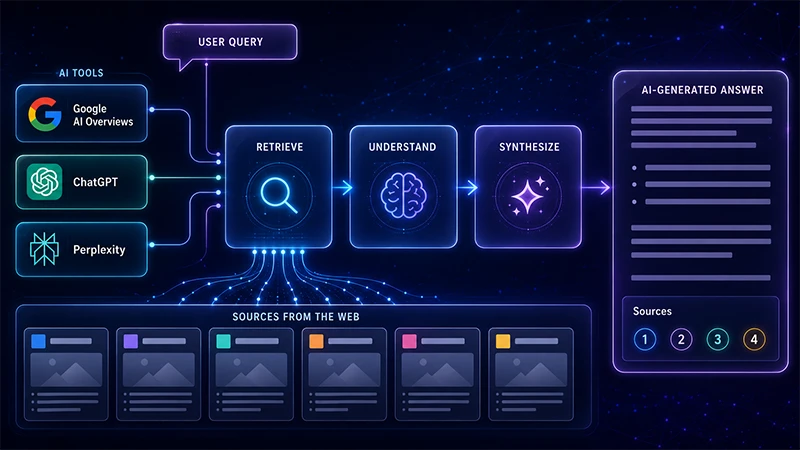
When a user submits a query to platforms like Google AI Overviews, ChatGPT, or Perplexity, these systems do not simply display a list of websites. Instead, they activate a complex pipeline that scans high-authority sources, extracts the most relevant information, and generates a cohesive response. This synthesis process relies on the model ability to read the internet in real-time. For businesses in a bustling market like Delhi, being cited by these engines requires your content to be presented in a way that is easily readable and highly relevant to the context of the user query. This allows the AI to integrate your insights seamlessly into its narrative.
Retrieval-Augmented Generation (RAG): The Core Technology Powering AI Answers
Retrieval-Augmented Generation is the technical backbone that makes generative search possible. It is a framework that allows an AI model to connect to external, real-time data sources to provide more accurate and up-to-date answers than the model pre-trained knowledge base alone.
- Retrieval: The system functions by scouring a massive, trusted index of web pages to locate information that matches the specific intent of the user prompt. This process involves sophisticated vector searches that go beyond simple keyword matching to understand the semantic meaning of your content.
- Augmentation: Once the relevant data is retrieved, the system enhances the user prompt by incorporating this fresh context. This ensures the AI model is not relying solely on its internal training, which might be outdated or too general, but is instead using specific, verified information retrieved from your website to build its response.
- Generation: In the final step, the model uses its advanced natural language processing capabilities to synthesize the retrieved data into a concise, human-readable response. It then intelligently includes citations back to the source websites, providing users with the ability to verify the information.
For brands, this means that your content must be structured to be easily retrieved during the search phase. If your data is fragmented, poorly labeled, or lacks clear context, the system is less likely to pull it, regardless of your domain authority.
Why Traditional Keyword Stuffing Completely Fails in Generative Search
In the era of legacy SEO, stuffing keywords into a page was a common, albeit flawed, tactic to trick algorithms. In the generative era, this strategy is not only ineffective but can be detrimental. AI models are trained to prioritize semantic relevance, logical flow, and intent fulfillment. When a system detects unnatural repetition, it flags the content as low-quality, which reduces the likelihood of it being used as a source. AI engines look for expert synthesis and helpfulness. They prioritize content that answers the why and how behind a query, not just content that repeats the what.
2. The Algorithmic Mechanics: How AI Engines Pick Sources
The Citation Framework: How AI Models Attribute Links to Web Assets
The citation mechanism is how AI engines validate their responses. When a model builds an answer, it cross-references the retrieved information with its internal confidence scoring. If your content is consistently cited, it is because the engine views your page as a source of truth. These citations are often placed as footnotes or hyperlinked text within the AI-generated response. The mechanics rely on the information relevance to the specific segment of the answer, meaning you must have highly granular, well-structured sections on your pages that correspond to specific user questions.
Information Density: Why Direct, Expert Answers Outrank Long-Form Fluff
Generative engines value information density. This is the measure of how much useful, actionable information is contained within a specific word count. Because these models aim to provide instant answers, they gravitate toward content that gets to the point quickly, utilizes structured data, and provides depth without unnecessary filler. For a professional service provider in Delhi, this means your service pages should lead with direct answers to common industry problems, supported by expert evidence, rather than long-form, generic narratives that offer little unique value to the reader.
The Trust Layer: How E-E-A-T and Brand Authority Influence LLM Training Data
While traditional SEO focuses on Experience, Expertise, Authoritativeness, and Trustworthiness as a signal for Google ranking algorithms, this is even more critical in the world of GEO. LLMs are trained on massive datasets that include assessments of brand authority. If your brand is frequently mentioned in industry-relevant contexts, social media discussions, and reputable news outlets, this signals to the AI that you are a trusted entity. Building a robust digital footprint outside of your own website creates a halo effect that improves your chances of being cited in generative search results.
Sentiment Analysis and Brand Favorability in LLM Responses
Modern AI models are increasingly capable of performing sentiment analysis on the data they ingest. They evaluate whether a brand is discussed positively, neutrally, or negatively in the public domain. If an AI engine is tasked with recommending services, it may synthesize information from reviews, forums, and press releases to gauge the favorability of a brand. Consequently, maintaining a positive reputation in local directories and industry platforms is a component of GEO. A brand with a consistently positive sentiment profile is more likely to be included in an AI-generated summary than a brand with mixed or poor public feedback.
3. Core Action Plan: Technical & Content Frameworks for GEO
Implementing Advanced Entity Schema to Feed Machine Learning Models
Schema markup is the language of the machine. By implementing advanced entity schema such as Product, Organization, Person, and LocalBusiness types, you provide AI engines with structured data that defines exactly who you are, what you offer, and where you operate. Instead of leaving the AI to guess the context of your business, you serve it a map of your brand identity. This is particularly important for businesses in competitive regions, as it helps the model differentiate your specific business profile from generic industry terms.
Structuring Data Using the “Claim-Evidence-Source” Content Format
To increase your chances of being cited, your content should follow a specific format that makes it easy for AI to parse your expertise.
- The Claim: Start each section by stating the direct answer to the user query. By clearly defining the main point at the beginning, you ensure that the AI engine can easily extract the core message, making it a primary candidate for inclusion in an AI overview or summary.
- The Evidence: Provide the data, reasoning, or expert insights that support that claim. AI models weigh this evidence heavily because it provides the necessary substance for the answer. Using statistics, case studies, or expert quotes makes your content significantly more valuable to the model.
- The Source: Always include links to the original context or verify your information with citations that prove the veracity of your claim. This helps the AI engine attribute the information back to you, reinforcing your domain authority and encouraging the system to continue pulling from your site in the future.
By modularizing your content this way, you make it easy for an AI retrieval pipeline to grab a specific paragraph or list as a definitive answer to a user prompt, directly increasing your visibility in AI-generated responses.
Optimizing for Co-Occurrence: Associating Your Brand with Premium Industry Keywords
Co-occurrence refers to the tendency of certain terms to appear together in a specific context. AI models learn by identifying these patterns. If your website consistently discusses your services alongside high-value industry terms, geographic locations, and expert commentary, the AI learns to associate your brand with those concepts. For an SEO company based in Delhi, you would naturally aim to have your brand mentioned alongside terms like digital strategy, local SEO optimization, and enterprise search solutions to ensure that when an AI summarizes those topics, your brand is retrieved as a relevant entity.
Formatting Content for LLM Extraction: Tables, Lists, and Bulleted Summaries
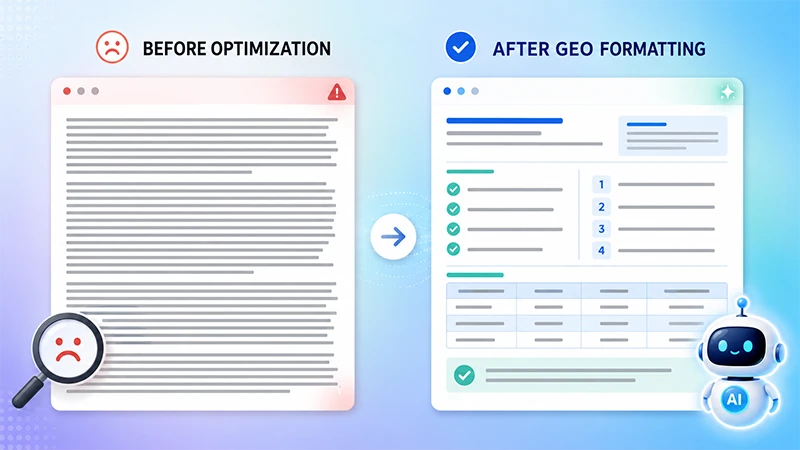
AI models are designed to process structured data efficiently. When content is organized into tables, numbered steps, or clear bulleted lists, the model can parse the information and transform it into a response format that it understands to be user-friendly.
- Tables: Tables are excellent for comparing features, pricing, or complex service specifications. Because tables present data in a row-and-column format, AI models can easily interpret the relationships between different data points, making this format perfect for high-density information.
- Bulleted Lists: Lists are ideal for providing quick tips, summarizing processes, or highlighting benefits. They allow the AI to extract specific action steps without needing to summarize long, flowing paragraphs, which increases the accuracy of the information provided to the user.
- Short Paragraphs: Keeping your explanatory text in short, focused paragraphs is the best way to provide context around data points. By avoiding overly long walls of text, you ensure the AI model can quickly scan and identify the key takeaway of each section.
Deploying these visual elements cleanly requires proper backend execution, as modern layouts must explicitly balance clean code with readable typography. Utilizing the resources of a reliable website designing company in Delhi guarantees that your custom templates are engineered to let LLM discovery bots ingest information effortlessly.
4. Localized GEO: Dominating AI Search in Regional Hubs and Delhi NCR
Hyper-Local Entity Mapping: Connecting Your Business to Physical Jurisdictions
To win in local AI search, you must be explicit about your physical presence. This goes beyond simple address blocks in your footer. You need to create content that maps your services to the specific neighborhoods and districts where you operate. By referencing local landmarks, regional industry hubs, and specific service areas, you provide the AI with the necessary geo-spatial context to link your business to a local user query. This ensures that when someone searches for a service in their immediate vicinity, your business is identified as a primary local entity. By working with a Delhi-based SEO company, businesses can build location-specific content, strengthen entity signals, and improve their visibility in AI-powered local search results.
Citations and Geo-Spatial Data: How Perplexity and ChatGPT Maps Handle Local Search
AI search engines are increasingly integrated with map-based data and location-specific databases. Your business must maintain consistent Name, Address, and Phone data across all major directories. When an AI model processes a local query, it validates your existence and location by cross-referencing your website data with reliable, third-party geo-spatial sources. If your address is inconsistent or your location data is absent from key directories, the AI may skip your business in favor of a competitor whose location data is verified and easily accessible.
Language Models and Regional Semantics: Tailoring Content for Diverse Indian Market Queries
The Indian digital market is characterized by linguistic diversity and unique search patterns. While English is the primary language for professional queries, local semantic variations are significant. Optimizing for GEO in a place like Delhi requires an understanding of how local users phrase their questions, including the integration of regional colloquialisms or specific industry terminology common in the local market. Tailoring your content to mirror the natural language and intent of your specific local audience improves your relevance within the LLM interpretation of those regional queries.
5. Multi-Engine Optimization: Tailoring for Google, OpenAI, and Perplexity
Google AI Overviews: Optimizing for the Search Generative Experience (SGE) Ecosystem
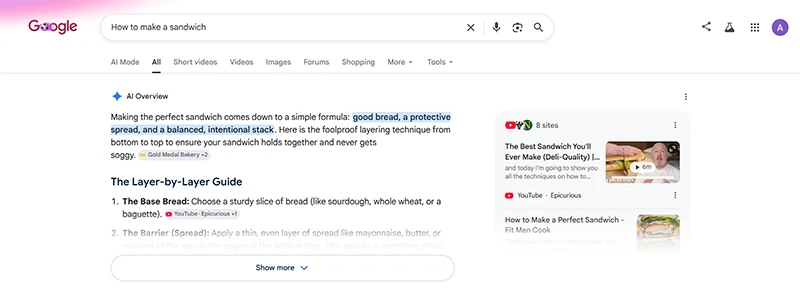
Google AI Overviews prioritize high-authority sources that align with Google’s Search Quality Rater Guidelines. To succeed here, your content must satisfy both the AI need for direct answers and Google traditional standards for expertise. Google is looking for sources that demonstrate a high level of authoritativeness. Focus on creating comprehensive, well-researched, and original content that addresses user intent directly. This is a hybrid approach where traditional SEO quality standards remain the foundation for generative visibility.
OpenAI & ChatGPT Search: Winning Citations in Conversational Interactivity
ChatGPT search emphasizes conversational flow and directness. When users ask ChatGPT questions, they are looking for a succinct, helpful response. Your content strategy for ChatGPT should focus on answering the who, what, when, where, and how as early as possible in your articles. Use conversational language that directly answers common questions about your industry. The goal is to provide a piece of information that is so clear and accurate that the model finds it the most natural choice to cite in its ongoing dialogue with the user.
Perplexity AI: Maximizing Footprint on the World’s Leading Answer Engine
Perplexity AI is a citation-heavy engine that treats the web as a massive, searchable knowledge base. It explicitly highlights its sources, making it one of the most transparent platforms regarding where it draws its information. To maximize your footprint on Perplexity, focus on depth and accuracy. Perplexity users are often researchers or professionals looking for verified facts. Providing detailed, source-backed content that includes data, industry statistics, and expert analysis makes your site an attractive target for the Perplexity retrieval engine.
6. Measuring Success: How to Track Your Website's AI Visibility
Monitoring AI Overview Tracking and Pixel Share in Modern SEO Tools
Traditional SEO metrics like keyword rankings and click-through rates are becoming less sufficient for measuring visibility. Instead, businesses must adopt new metrics such as AI Overview Presence and Pixel Share. These metrics track whether your domain is appearing in generative response blocks and how much screen real estate those blocks occupy. Several modern SEO tools are beginning to offer insights into AI visibility, allowing you to monitor how often your site is cited and for which query categories. Google also recommends following its guidance for optimizing your website for generative AI features on Google Search to improve how AI-powered search experiences interpret and surface your content.
Analyzing Referral Traffic Patterns From AI Discovery Engines
Referral traffic from AI engines often behaves differently than organic traffic from standard search results. You may see fewer direct clicks, but those that do arrive are often higher in intent, as the user has already received a summary of your service and is clicking through for more specific details or to perform an action. Analyze your analytics to identify traffic sources that originate from generative engines. This data helps you understand which pieces of content are effectively driving users from an AI-generated summary to your website conversion funnel.
Protecting Your Footprint Against LLM Attrition and Data Shifts
The landscape of AI is constantly changing. A model that prioritizes your content today might update its algorithms tomorrow. To protect your footprint, you must focus on building a resilient brand and high-quality, evergreen content that remains valuable regardless of small algorithmic shifts. Diversify your visibility across multiple AI engines rather than relying on one. By maintaining a high-authority domain and consistently providing expert, well-structured information, you ensure that your business remains a valuable, and therefore cited, entity in the long term.
Closing Thoughts: Understanding GEO
Generative Engine Optimization represents a fundamental shift in how digital information is discovered and delivered to users. As search engines transition from providing lists of blue links to synthesizing comprehensive, instant answers, the criteria for digital success have moved toward authority, clarity, and structural precision. This new landscape demands that businesses prioritize information density and machine-readable formats to ensure they remain the primary sources of truth for AI models.
By moving away from keyword stuffing and toward a strategy that prioritizes semantic relevance and entity clarity, you position your brand as a reliable expert in the eyes of both human users and generative systems. Ultimately, winning in this era requires a persistent focus on providing high-quality, verified data that fulfills specific user intent.
Frequently Asked Questions About GEO for Business Leaders
Will Generative AI search engines completely replace traditional website traffic?
Generative AI will likely change the composition of traffic, not eliminate it. While some quick answer searches will be satisfied within the AI interface, high-intent users will continue to click through to websites for deeper research, service evaluation, and direct engagement. Your goal is to capture those users who need more than just a summary.
Do I need a brand-new website architecture to optimize for GEO?
Not necessarily. In most cases, you can improve your GEO by auditing and enhancing your existing content, adding structured schema markup, and restructuring key pages into a Claim-Evidence-Source format. While some technical updates are required, a total site rebuild is rarely needed unless your existing architecture significantly hinders data accessibility.
Can a business pay to be featured inside Google’s AI Overviews?
No. Just like traditional organic search, AI-generated citations are driven by the engine assessment of relevance, trust, and information quality. You cannot pay to be cited in an AI Overview. The only way to improve your visibility is by producing superior, highly relevant content that the system deems worthy of inclusion.
How long does it take for a website to start showing up in AI engine citations?
The timeline depends on your existing domain authority and the frequency with which AI models crawl your site. If you implement structural improvements like schema and clear, expert-led content, you may start seeing an impact within weeks, though building long-term authority in AI citations is an ongoing process that correlates with your broader brand-building efforts.
Does GEO replace traditional SEO, or do they work together?
GEO and traditional SEO work in tandem. Many of the fundamental requirements for GEO, such as content quality, domain authority, and technical health, are the same principles that drive traditional search performance. GEO is essentially an evolution of SEO, adding layers of structure and semantic relevance that are specific to the needs of generative models.
How do AI search engines handle localized B2B service queries in corporate hubs like Delhi?
AI engines handle these queries by analyzing the entity data associated with the business, including its verified location, industry expertise, and presence in local directories. By ensuring your business has a strong, consistent digital identity verified through local citations and clearly structured content on your website, you provide the AI with the necessary signals to identify your business as a relevant service provider within specific geographic hubs like Delhi.
Strengthen Your AI Search Visibility
If you are looking to improve your visibility across traditional and AI-powered search platforms, our SEO team delivers data-driven strategies that combine proven SEO techniques with Generative Engine Optimization (GEO). We help businesses build authority, improve local visibility, and increase their chances of being cited in AI-generated search results. Contact us today to discuss an SEO strategy tailored to your business goals.