
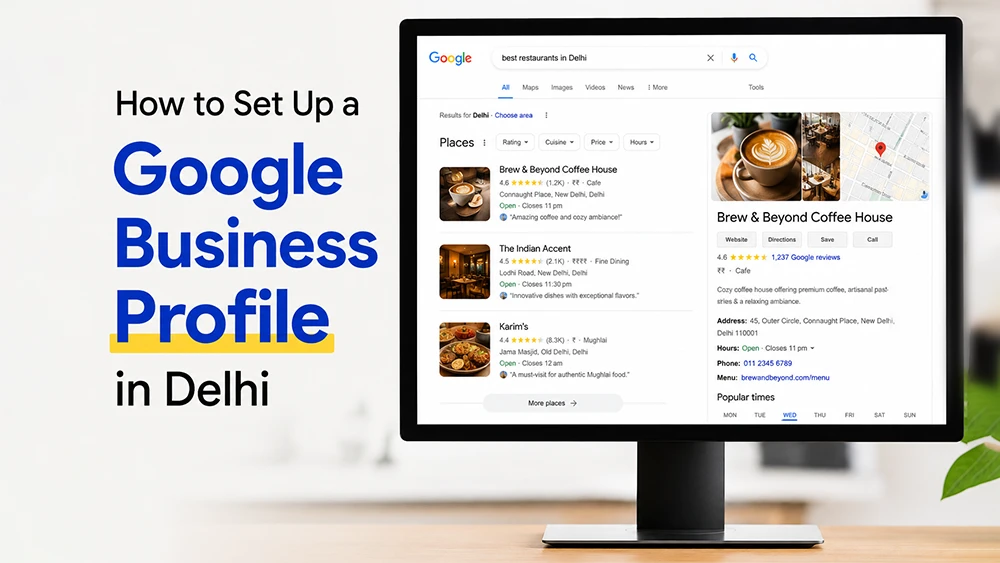
Why Google My Business is Critical for Growth
Understanding the strategic value of your profile is the first step toward achieving market dominance in the city.
1. Your Digital Front Door in the NCR
For many customers, this profile is the first interaction with a business. People check photos, reviews, and hours online before deciding to visit or inquiry, making a strong first impression vital. Providing accurate details helps convert these digital searches into high-value physical visits and confirmed leads.
2. Dominating the Local 3-Pack
Appearing in the top three map listings significantly improves visibility for mobile users. A properly optimized GBP listing allows smaller businesses to gain better visibility than bigger competitors by using accurate, regular updates.
3. The Zero-Click Revolution
Modern users expect quick information without navigating multiple pages. Profiles display phone numbers, hours, and directions directly in results, simplifying communication and allowing users to contact or visit the business immediately.
4. Building Instant Trust (The Delhi Verification)
A verified GMB profile helps establish authenticity and reassures users that the business is legitimate. Consistent activity through photos and posts signals that the business is operational, responsive, and actively serving its customers.
5. Voice Search and AI Readiness
Modern search relies on Answer Engine Optimization (AEO) and Generative Engine Optimization (GEO) to provide instant, high-accuracy results. Your profile acts as a primary data source, allowing AI models and voice assistants to cite your business as a trusted authority during natural-language local queries.
6. Business Intelligence and Heat Maps
Profile Insights provide valuable data about customer behavior and search origins. These trends help businesses understand busy periods, supporting better staffing decisions and operational improvements during high-demand hours in the market.
7. Cost-Free Lead Generation
A GMB profile generates consistent visibility without ongoing advertising expenses. Businesses receive calls, direction requests, and website visits organically through exposure, providing a sustainable growth strategy without relying on high paid budgets.
Steps to Set Up Your Google Business Profile
Following a systematic approach ensures your listing remains compliant and visible to your target audience. Proper configuration from the start prevents common verification delays and establishes a strong foundation for your local online presence.
Step 1: Check for Existing or Duplicate Listings
- The Search Phase: Before creating a new account, search for your business name and address on Google Maps. Many local enterprises have “auto-generated” listings created from third-party data or older unclaimed profiles.
- Claiming an Existing Profile: If a listing exists, click “Own this business?” and follow the prompts. Creating a second profile for the same location is a violation that leads to immediate suspension, so always check for duplicates first.
Step 2: Access the Official Google Business Interface
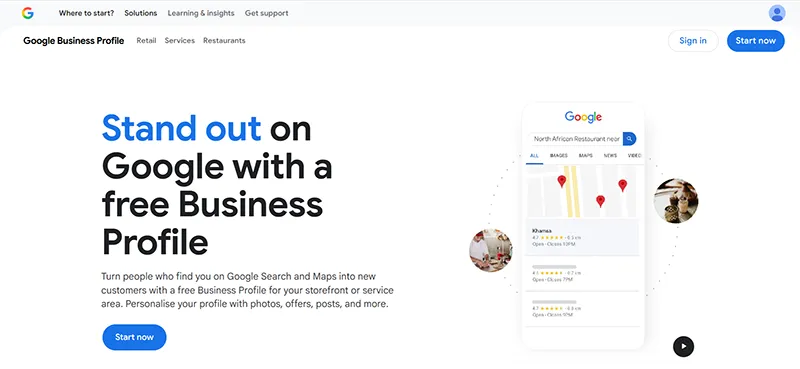
- Log In: Use a professional Gmail account, ideally one linked to your business domain. This keeps your business and personal communications separate and professional.
- Start the Setup: Visit the Google Business Profile manager and select “Add your business to Google.” This initiates the official onboarding flow to get your business indexed on Maps and Search.
Step 3: Enter Your Official Business Name and Category
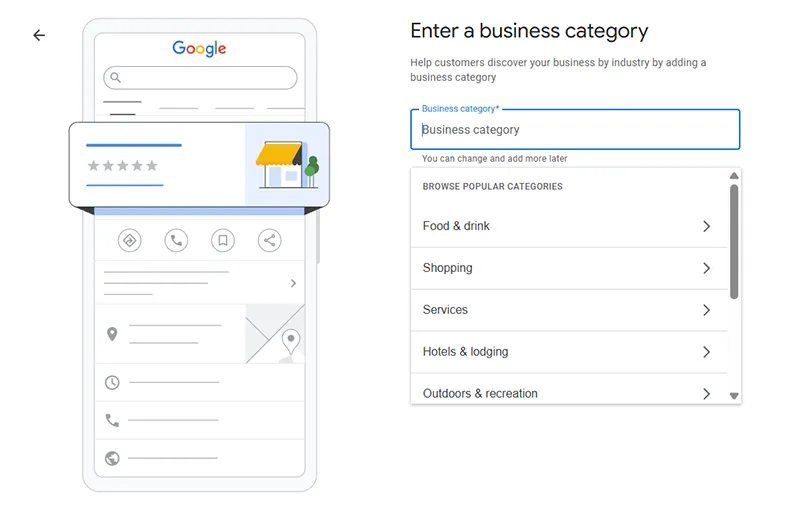
- Legal Business Name: Use the exact name that appears on your shop board or tax documents. Do not add cities or keywords to the name. For example, use “Rajiv Electronics,” not “Rajiv Electronics Best Shop in Delhi.” You should review the official Guidelines for representing your business on Google to avoid common naming violations.
- Primary Business Category: Select the most specific category available. If you are a specialized lawyer, choose “Divorce Lawyer” or “Corporate Lawyer” rather than just “Lawyer.” This choice is the most influential factor in determining which specific searches your business appears in.
Step 4: Specify Your Location Type
- Physical Storefront: If you have a shop or office where customers visit, enter the full address, including the floor and suite number. This places a permanent pin on Google Maps.
- Service-Area Business: If you provide services at the customer’s location, such as home repairs, hide your physical address. Instead, select the specific regions or PIN codes you serve to define your operational boundary without showing a home office.
Step 5: Input Accurate Contact and Messaging Channels
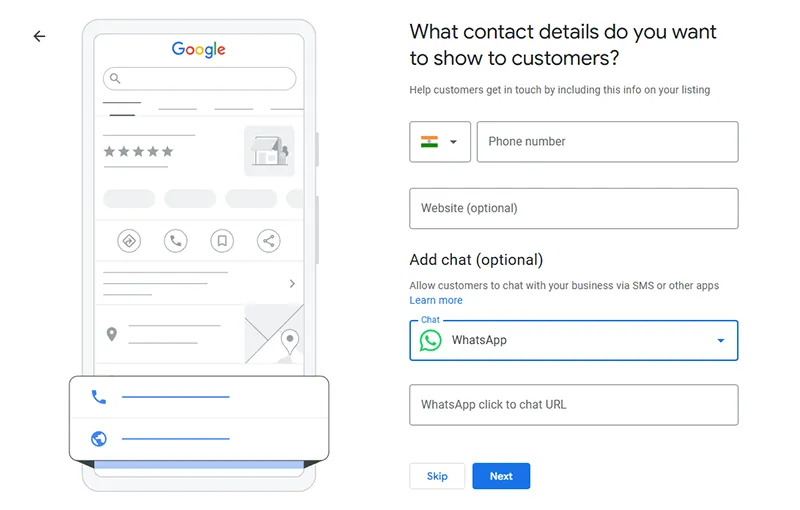
- Primary Phone Number: Provide a number where someone is always available to answer. A local 011 landline often carries more local trust than a mobile number for established firms.
- WhatsApp Business Integration: In 2026, the Contact menu includes a dedicated Chat section. Use the dropdown to select WhatsApp instead of standard text messaging to enable modern rich-media communication features.
- The Click-to-Chat URL: For maximum compatibility, use the official format https://wa.me/91XXXXXXXXXX. This creates a direct button on your mobile listing, allowing customers in busy markets to send location pins instantly.
- Website URL: Link to your official website. Ensure the website also lists the same address and phone number to maintain high data consistency across all your verified digital platforms.
Step 6: Complete the Verification Process
Video Verification is currently the primary method. In 2026, most businesses must provide a live or recorded video showing:
- Exterior: Your shop sign and the surrounding street, highlighting nearby landmarks or Metro Pillar numbers to prove the physical location exists.
- Equipment: Your billing machine, stock, or professional tools. For service businesses, show your branded vehicle or tools of the trade.
- Management: Proof of access, such as opening the shop shutter with a key or logging into your business software to prove you are the owner.
- Postcard Verification: If video is not available, Google will mail a code to your physical address. This usually takes 10–14 days and remains a backup for specific regions.
Step 7: Add Business Hours and Services
- Standard Hours: Set your regular opening and closing times. Accuracy here prevents frustrated customers from arriving at a closed shop.
- Customizing Locally: Account for “Market Off-Days” where specific neighborhood markets may be closed on certain weekdays. You can also set “Special Hours” for upcoming public holidays.
- Detailed Services: List exactly what you offer, such as “AC Installation,” “Screen Repair,” or “Tax Consultation.” This helps your profile show up for long-tail service-specific queries.
Step 8: Upload High-Resolution Visuals
- Exterior & Interior: Upload at least 3–5 photos of the outside and inside of your premises. High-quality imagery builds visual trust and helps customers recognize your building.
- Team and Work: Show your team in action or photos of completed projects. Humanizing your business creates a stronger connection with potential local customers.
Step 9: Final Review and Optimization
- Profile Completeness: Ensure the bar at the top of your dashboard shows 100% completion. A finished profile is prioritized by algorithms over incomplete ones.
- Ongoing Management: This technical setup is the foundation. This profile should be monitored weekly for changes, customer queries in the Q&A section, or new reviews that require a response. Learn how to edit and manage your profile to keep your information current.
Geographical Targeting: Defining Your Service Area
To achieve maximum visibility, your profile must reflect the specific neighborhoods and cities where you operate. In a sprawling metropolis like Delhi, proximity is a primary ranking factor for local queries.
The Importance of Granularity
Selecting “Delhi” as a whole is often too broad for effective targeting. The city is a collection of diverse micro-markets with distinct consumer behaviors. By narrowing your focus, you reduce competition against businesses on the other side of the city and increase your relevance for users searching “near me.” When you define specific service areas, you signal to the platform that you are the most convenient and authoritative choice for residents in those exact zones.
Specific Neighborhood Clusters in Delhi
Organizing your service area by clusters allows you to dominate specific high-value regions:
- South Delhi: Focus on affluent residential and commercial hubs like Hauz Khas, Saket, Greater Kailash, and Vasant Kunj. These areas have high search intent for premium lifestyle and professional services.
- West Delhi: Target major commercial centers and residential blocks such as Rajouri Garden, Janakpuri, and Punjabi Bagh. These are vital for retail and home-service businesses.
- North & East Delhi: Include high-density regions like Rohini, Model Town, Laxmi Nagar, and Preet Vihar. These clusters represent a massive consumer base for essential local services.
- Business Hubs: Ensure coverage for major corporate and industrial sectors including Connaught Place, Okhla Industrial Area, and Netaji Subhash Place.
NCR Expansion: Reaching Beyond Delhi
If your business has the capacity to serve the broader National Capital Region, you should explicitly include these major satellite cities in your Service Area settings:
- Noida: Essential for businesses targeting the IT corridors, media houses, and residential sectors of Uttar Pradesh.
- Gurugram: The primary hub for corporate clients, multinational headquarters, and high-end residential complexes in Haryana.
- Ghaziabad: A key industrial and residential expansion zone that connects your business to a vast suburban audience.
- Faridabad: A major industrial center that provides access to the manufacturing and trade sectors of the NCR.
Hidden Neighborhoods and Hyper-Local Relevance
To truly stand out, look beyond major district names. Mentioning specific blocks (e.g., “Sector 62 Noida” or “DLF Phase 3 Gurugram”) or local colonies increases your relevance for hyper-local queries. When a user in a specific colony searches for a service, a profile that explicitly mentions their neighborhood is more likely to appear in the local pack. This level of detail builds trust, as customers prefer businesses that demonstrate clear local knowledge and accessibility within their immediate surroundings.
Strengthening Authority through Local Citations
Building digital authority requires more than just a verified profile; it requires consistent mentions across the web. These citations act as trust signals that validate your business’s physical existence and professional standing. To get started, you can follow this guide on how to build local citations to ensure your business is listed on the most impactful platforms.
The Power of Consistency
Ensuring your Name, Address, and Phone (NAP) data matches across every platform is non-negotiable. Even minor discrepancies, like using “St.” on one site and “Street” on another, can confuse algorithms and weaken your local authority.
Many business owners ask, does NAP consistency matter for local SEO in the modern search landscape? The answer is a resounding yes. A consistent NAP profile across the internet confirms to digital platforms that your business data is reliable, which directly influences your appearance in local map results and builds long-term trust with your audience.
High-Authority Indian Directories
Registering your business on these established platforms creates a robust network of citations:
- Justdial: Utilizing India’s oldest and most popular directory is essential for high-volume lead generation. It remains a primary source of information for local residents seeking immediate services.
- Sulekha: Focusing on service-oriented listings here helps build long-term authority, especially for home services, education, and professional consultations.
- IndiaMART: As the largest B2B marketplace in the country, a listing here is vital. For businesses located in Okhla, Mayapuri, or Patparganj Industrial Areas, a citation here is a powerful signal of “Trade Authority” within the commercial sector.
- TradeIndia: While similar to IndiaMART, TradeIndia has a strong focus on manufacturing and export-import. It is a critical citation source for wholesalers and industrial suppliers.
Industry-Specific and Niche Portals
General directories are important, but industry-specific portals provide the most relevant authority. Finding niche directories for real estate, healthcare, or retail specifically within the National Capital Region (NCR) can give you a competitive edge. These platforms often rank well for specific professional queries, ensuring your business is visible to a highly targeted audience looking for specialized expertise in your local area.
Best Practices for Managing Your Google Business Profile in Delhi
Consistent management of your profile ensures your business remains the top choice for local customers. Active maintenance signals to the platform that your enterprise is reliable, operational, and deeply connected to the regional community.
1. Maintain Strict Data Integrity (The NAP Rule)
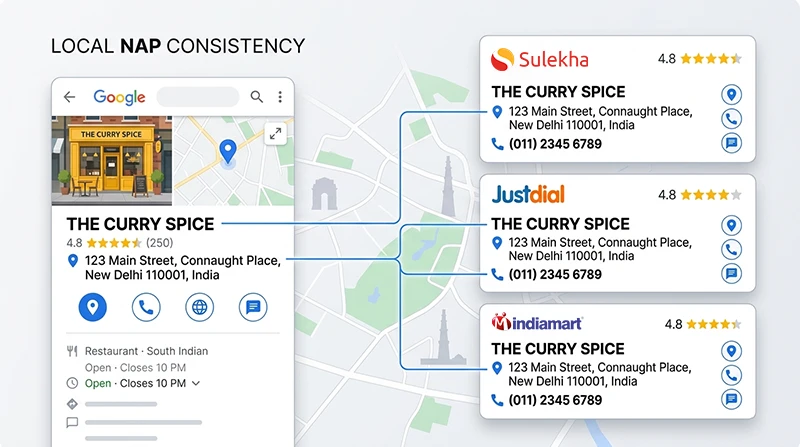
Ensure your Name, Address, and Phone number are 100% identical across your website, Google profile, and local directories. You must standardize your address format for complex localities, such as always using a specific plot number and floor rather than varying it. This uniformity prevents ranking drops and ensures data reliability.
2. Optimize with a Laser-Focused Primary Category
Choose the most specific category that defines your core revenue driver to capture the right traffic. Instead of a broad professional title, select a precise specialization that fits your expertise. Researching local competitors in your specific business hub ensures you are not fighting for the wrong audience while increasing niche relevance.
3. Deploy High-Fidelity, Real-World Imagery
Use photorealistic, high-resolution images of your actual premises to build immediate visual trust with potential visitors. Include at least one street-view shot of your signage to help customers navigate dense urban areas, plus interior shots that prove your business is active, legitimate, and highly professional for all visiting customers.
4. Execute a 24-Hour Review Response Loop
Respond to every review, whether positive or negative, within one business day to show you value feedback. For positive feedback, thank the user and mention the specific neighborhood to boost local relevance. For negative feedback, provide a professional, offline resolution path to demonstrate accountability and a commitment to customer satisfaction.
5. Update Weekly with Local-First Posts
Use the Update feature at least twice a week to share news, offers, or behind-the-scenes content. Align your posts with the local calendar by mentioning weather shifts, festival timings, or regional events to show the platform that you are an active and live part of your specific urban community.
6. Consolidate into a Single Source of Truth
Regularly audit for and merge any duplicate listings that might have been created by users or third-party directories. Concentrating all your reviews and check-ins into one profile prevents your authority from being split across multiple weak listings. This consolidation strengthens your overall ranking power and builds a more trustworthy reputation.
7. Use Localized Service Area Settings
If you are a service-based business, define your area by specific PIN codes or neighborhood names rather than a generic radius. This precision ensures you appear for “near me” searches in relevant hubs without wasting reach on areas you do not actually cover, maximizing your local visibility and conversion potential.
8. Leverage the Q&A Section Proactively
Do not wait for customers to ask questions; post your own frequently asked questions and answer them yourself. Focus on addressing common regional concerns like parking availability or home visit options to provide immediate value and clear any potential barriers that might prevent a customer from choosing your services.
9. Activate Direct Messaging for Instant Leads
Enable the Chat feature and ensure someone is available to respond during business hours to capture fast leads. The fast-paced market prefers instant chat over waiting for an email reply. Maintaining a high response rate through this direct channel makes it a vital tool for converting inquiries into confirmed sales.
10. Audit Your Insights for Geographic Trends
Monthly, review where your direction requests are coming from to understand your customer base distribution. If you see a spike in searches from a specific neighborhood, you can tailor your next post specifically for customers in that region. Using this actionable data allows for highly targeted and effective marketing campaigns.
For those looking to master these metrics, referring to a beginner’s guide to Google Business Profile can help you interpret this actionable data for highly targeted and effective marketing campaigns.
Tips to Hire GMB Expert in Delhi
Finding the right GMB expert in Delhi ensures your local presence is managed with technical precision and market awareness.
1. Check for Local Experience
The expert must demonstrate a deep understanding of the city’s unique commercial landscape and neighborhood boundaries. A specialist who knows the difference between a high-street retail hub and an industrial estate can better optimize your service area settings. This local knowledge ensures your business targets the most relevant traffic.
2. Verify Success Stories
When hiring, check for success in competitive local niches like hospitality, healthcare, or professional services within the NCR. An expert should be able to demonstrate how they have improved visibility and lead generation for similar businesses through strategic profile management. Evidence of past growth is the most reliable indicator of future results.
3. Assess Technical Knowledge
Ensure the expert understands modern verification hurdles and high-quality image standards required for a professional listing. They should be well-versed in technicalities like managing bulk uploads, resolving suspensions, and staying updated with the latest algorithm changes. This expertise ensures your GBP listing remains compliant while utilizing the newest features available on the platform.
4. Review Communication Skills
Managing your digital reputation requires a proactive and professional communication strategy for both positive and negative feedback. Inquire about their process for handling queries and reviews within a tight twenty-four-hour timeframe. A specialist who maintains a consistent, brand-aligned voice helps build long-term credibility and encourages significantly higher levels of customer engagement.
5. Evaluate Content Strategy
It is vital to hire someone who prioritizes unique descriptions and localized updates for every profile they manage. Avoid professionals who rely on automated templates or repetitive copy. High-quality, human-centric content is essential for building trust with potential customers and maintaining a “live” signal that helps sustain high local rankings.
6. Understand the Investment
Local search services in Delhi are a fundamental part of a modern growth strategy rather than an optional expense. Investing in professional management ensures your GBP listing remains a high-performing asset that consistently generates organic leads. You should look for transparent pricing models that reflect the value of the long-term ROI provided to your business.
7. Demand Transparent Reporting
Reliable professionals provide clear, regular updates on profile health, ranking shifts, and lead generation metrics. You should avoid consultants who make vague promises of success without showing the actual work performed on your dashboard. Transparency in their workflow ensures you remain in total control of your digital asset while it grows steadily.
Conclusion on Setting Up a GBP in Delhi
Treating your profile as a living asset rather than a set and forget task is the key to long-term success. For 2026, the final checklist includes verifying your location via video, maintaining absolute NAP consistency, and engaging with your audience through weekly updates and rapid review responses.
Prime SEO can help you navigate the complexities of setting up and managing your Google Business Profile. Our SEO expert in Delhi manages your GBP to ensure your business remains accessible to local customers. Contact us today to transform your local visibility and start appearing in the search results in your neighborhood.