
To achieve high visibility on search engine results pages, small businesses must adopt a structured, multifaceted SEO strategy. Tailoring a strategy for SEO for small businesses demands a disciplined execution of technical optimizations, user-centric content creation, and regional search targeted approaches.
In-depth Keyword and Intent Research
Keyword research forms the foundation of any successful search strategy. Rather than targeting overly broad search terms dominated by national conglomerates, effective SEO for small business relies on discovering the sweet spot between search volume, low competition, and strong commercial intent. Identifying long-tail keywords allows small enterprises to capture prospects who are further along in the buyer decision lifecycle.
Search intent can generally be divided into four distinct categories:
- Informational Intent: Users searching for answers, guidebooks, or explanations (e.g., “how to clean commercial carpets”).
- Navigational Intent: Users attempting to locate a specific brand or web page (e.g., “Apex Logistics portal”).
- Commercial Investigation Intent: Users comparing solutions before purchasing (e.g., “top-rated accounting software for boutique firms”).
- Transactional Intent: Users fully prepared to make a purchase or request a service immediately (e.g., “hire emergency plumber near me”).
By mapping long-tail search terms to specific landing pages, small businesses can attract traffic that directly generates sales inquiries.
Optimizing for Local Search (Local SEO)
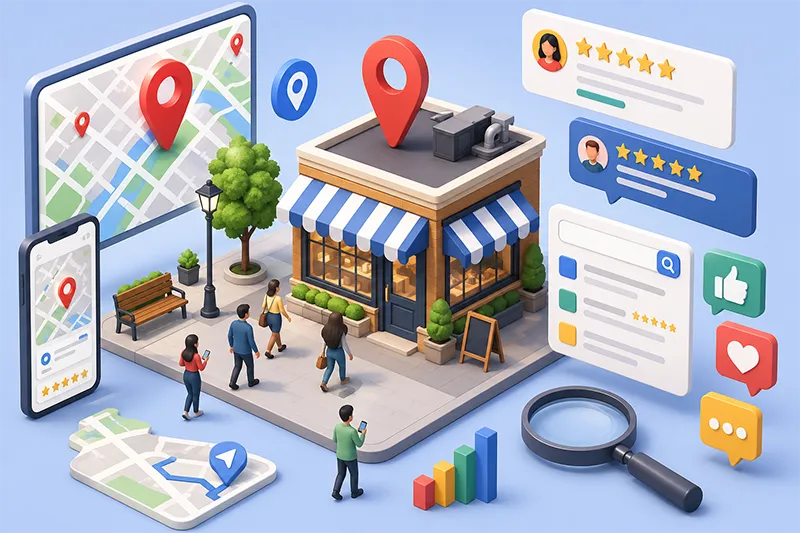
For service providers and local stores, geographical search optimization yields the fastest return on investment. Implementing effective local SEO for small business tactics ensures your brand dominates Google Maps and regional search results.
Top SEO companies for small business focus on fully optimizing your Google Business Profile, updating local citations, and creating location-tailored content. Businesses serving Delhi NCR, Noida, Gurugram, Ghaziabad, Faridabad, and nearby neighbourhoods should create dedicated location pages for the areas they serve. Establishing verified local signals helps businesses improve visibility in local search results and outperform non-local competitors.
On-page Optimization
On-page optimization focuses on optimizing individual website elements so search engines can easily understand the context and relevance of your pages. Proper SEO optimization for small business involves meticulously crafting meta tags, heading hierarchies, URL structures, and internal text elements.
- Meta Title Tags: Include your primary keyword near the beginning of the title while keeping the total length under 60 characters to prevent truncation on search engine results pages.
- Meta Descriptions: Write compelling 155-character descriptions that include relevant search terms and a clear call to action to maximize click-through rates.
- Header Tags (H1, H2, H3): Organize your web pages using clear heading hierarchies. Reserve H1 tags for main page topics and use H2/H3 tags to outline supporting ideas cleanly.
- Image Optimization: Compress image file sizes to preserve loading speed and craft descriptive alt text featuring target terms to assist search bots and accessibility screen readers.
- Clean URL Structures: Keep page URLs short, descriptive, and keyword-rich, avoiding random numeric parameters or complex special characters.
Creating High-Quality, Semantic Content
Search engines prioritizing semantic understanding reward websites that offer broad, authoritative answers to user queries. Incorporating search engine optimization for small businesses into content planning means writing comprehensively around core operational themes rather than publishing brief, surface-level articles.
Semantic content creation involves integrating Latent Semantic Indexing (LSI) terms and natural entities related to your primary topic. For example, an article about office renovation should naturally incorporate terms like “floor plans,” “commercial permits,” “interior acoustics,” and “project timelines.” Developing comprehensive content hubs that thoroughly address customer questions demonstrates topical authority, prompting search algorithms to rank your pages higher.
If you are looking for practical tips for SEO for small businesses, focusing on comprehensive, user-focused content is one of the most effective ways to improve long-term organic visibility.
Technical SEO Foundations
Technical search engine optimization ensures that search engine crawlers can seamlessly access, index, and render your website content. Sound technical SEO for small businesses creates an infrastructure that prevents indexing errors and delivers exceptional performance.
- Page Speed Optimization: Leverage browser caching, minimize CSS/JavaScript files, and utilize Content Delivery Networks (CDNs) to achieve rapid page render times.
- Secure HTTPS Protocol: Install an SSL certificate to protect visitor data and avoid browser security warnings that deter potential customers.
- XML Sitemaps: Generate and submit an updated XML sitemap through search console portals to guide search engine bots through your complete site structure.
- txt Configuration: Ensure your robots.txt file grants crawlers access to valuable content pages while blocking unnecessary admin or staging URLs.
- Crawl Budget Efficiency: Eliminate broken 404 links, fix unnecessary redirect chains, and clean up duplicate content to maximize crawler efficiency.
Mobile-First Optimization
Google operates strictly on mobile-first indexing, evaluating the mobile edition of your website to determine search rankings. If your site offers a substandard mobile experience, your overall organic visibility will suffer across desktop searches as well.
Mobile optimization requires dynamic responsive web layouts that auto-adjust seamlessly to varying viewport sizes. Mobile pages must feature readable font scaling, spacious touch targets for buttons, fast interactive response times, and lightweight visual assets. Monitoring your performance metrics via Google’s Core Web Vitals helps maintain high mobile rendering standards.
Strategic Internal Linking
Internal linking establishes a logical architecture across your website while distributing contextual authority (PageRank) from high-performing landing pages to newer content assets. A structured internal link strategy helps search engines discover new web pages and contextualize relationships between topics.
When inserting internal links, utilize descriptive anchor text that incorporates descriptive search terms instead of generic phrases like “click here” or “learn more.” Grouping related pages into dedicated topic clusters anchored by pillar pages guides users smoothly through their buying journey while boosting overall domain authority.
Building High-Quality, Relevant Backlinks
Backlinks serve as digital votes of confidence from third-party websites. Search algorithms interpret incoming links from authoritative, contextually relevant sources as signals of trust and technical competence. Consequently, link building in SEO for small business remains a major factor in driving high organic rankings.
Small businesses should focus on earning high-quality, natural backlinks through ethical digital outreach rather than purchasing bulk low-quality link packages. Effective strategies include:
- Publishing original industry research, infographics, or local market guides that other blogs naturally link to.
- Engaging in targeted digital PR outreach to land feature coverage on regional news platforms and industry journals.
- Partnering with local non-profit organizations or sponsoring regional community events to earn authoritative community links.
- Reclaiming unlinked brand mentions by asking webmasters to add hyperlinks to existing editorial mentions of your company name.
Implementing Schema Markup
Schema markup (structured data) provides explicit code instructions to search engine bots regarding the precise meaning of your web content. Adding JSON-LD structured data code assists search engine parsers in recognizing your business entity, operating hours, geographical locations, customer rating reviews, and service portfolios.
Implementing LocalBusiness schema helps search platforms display interactive rich snippets directly in main search results, increasing click-through rates. Schema options like FAQ markup, product pricing schema, and article schema enhance visual search listings, giving small enterprises a modern, high-tech search profile.
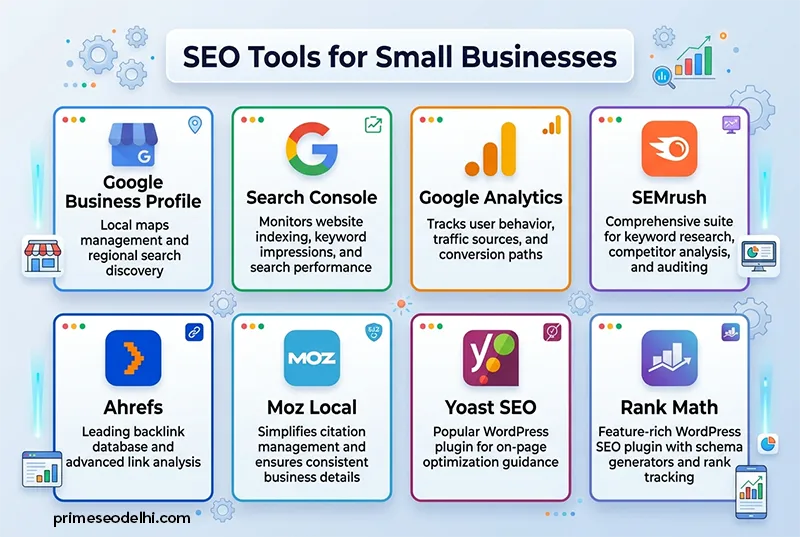
Managing organic search visibility requires actionable insights from specialized software platforms. Selecting the appropriate software toolset allows resource-conscious business owners to track performance metrics, identify technical bugs, and discover high-value market keywords efficiently.
Google Business Profile
Google Business Profile is the primary tool for driving regional search engine discovery. It lets small businesses manage their localized Google Maps presence, publish operational updates, upload media, and collect client reviews directly on Google search interfaces.
Google Search Console
Google Search Console provides primary data on how Google’s crawling bots index your website. This free tool reveals keyword impressions, click-through rates, crawl errors, mobile usability issues, and manual penalties, making it an essential diagnostic platform.
Google Analytics
Google Analytics delivers deep data insights regarding user interactions on your website. It tracks traffic sources, user dwell times, bounce rates, conversion paths, and audience demographics, allowing business owners to refine content based on real visitor behavior.
SEMrush
SEMrush is a comprehensive digital marketing platform offering tools for keyword research, competitor link analysis, site auditing, and rank tracking. Choosing scalable tools for SEO for small business management enables small teams to audit competitors and uncover high-converting search terms.
Ahrefs
Ahrefs is renowned for its industry-leading backlink database and web crawling capabilities. It allows small businesses to analyze competitor link profiles, discover content gaps, audit internal technical link architecture, and identify lucrative outreach opportunities.
Moz Local
Moz Local simplifies citation management by automatically distributing accurate business information across major location aggregators and directory databases, ensuring consistent business details across the web.
Yoast SEO
Yoast SEO is a popular WordPress plugin that simplifies on-page optimization. It provides real-time guidance for crafting meta tags, generating XML sitemaps, managing canonical tags, and structuring content readability.
Rank Math
Rank Math is a feature-rich, lightweight WordPress SEO plugin that offers integrated schema markup generators, rank tracking capabilities, broken link monitoring, and deep Google Search Console integrations directly within your content management system.

Managing organic search strategy internally can quickly overwhelm small business teams. Partnering with professional agencies that deliver SEO services for small businesses grants access to dedicated expertise, enterprise technology, and proven execution frameworks without the overhead of hiring an in-house team.
Access to Expert Strategy
Search algorithms update constantly throughout the year. Partnering for SEO for small business growth connects you with dedicated specialists who closely track algorithm updates, preventing sudden ranking drops and ensuring your site stays compliant with modern webmaster guidelines.
Time Savings for Business Owners
Managing technical site audits, keyword research, content drafting, and link outreach demands dozens of hours each week. Outsourcing search optimization to an experienced team lets business owners focus on operations, sales, and client management.
Advanced Enterprise Tools
Leading SEO tools cost thousands of dollars annually per user license. Partnering with top agency teams providing the best SEO services for small business gives you immediate access to enterprise-grade crawler tools, rank trackers, and analytics software without individual tool fees.
Holistic Integration
Leading digital agencies do not treat search optimization as an isolated tactic. Whether supporting SEO for startups or established businesses, they integrate search strategy with web development, conversion rate optimization (CRO), user experience design, and digital marketing to maximize overall lead conversions.
Data-Driven, Measurable ROI
Professional agencies deliver structured monthly performance reporting that ties keyword movements directly to website traffic, qualified leads, and business revenue growth. Working with specialists offering affordable SEO services for small businesses provides transparent, data-driven reporting tailored to your specific growth targets.